



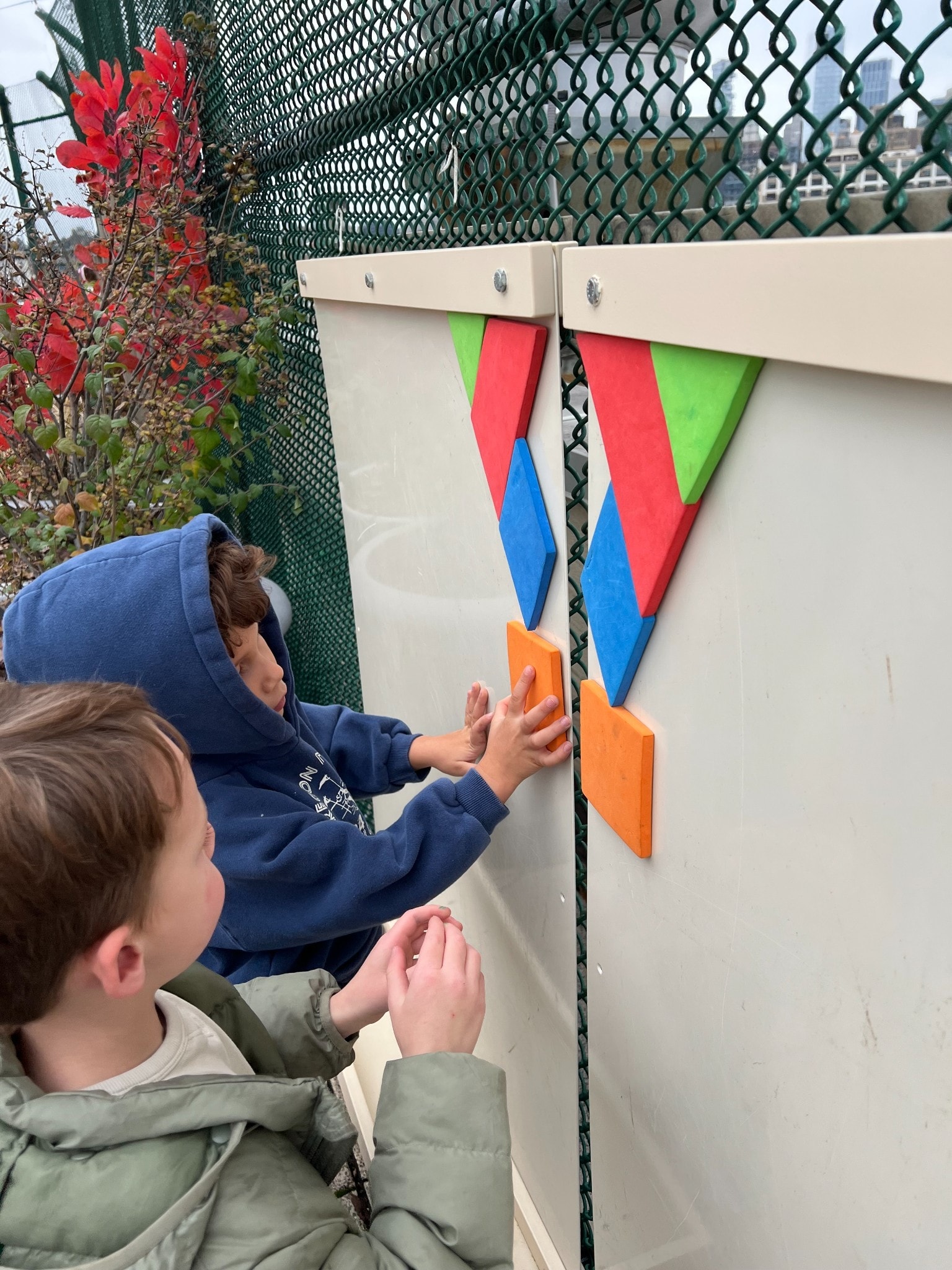
Over the past two weeks, the students have continued their examination of line symmetry*.
*Line symmetry (also known as reflectional symmetry or mirror symmetry) is a fundamental geometric property where one half of an image or object is the mirror image of the other half.
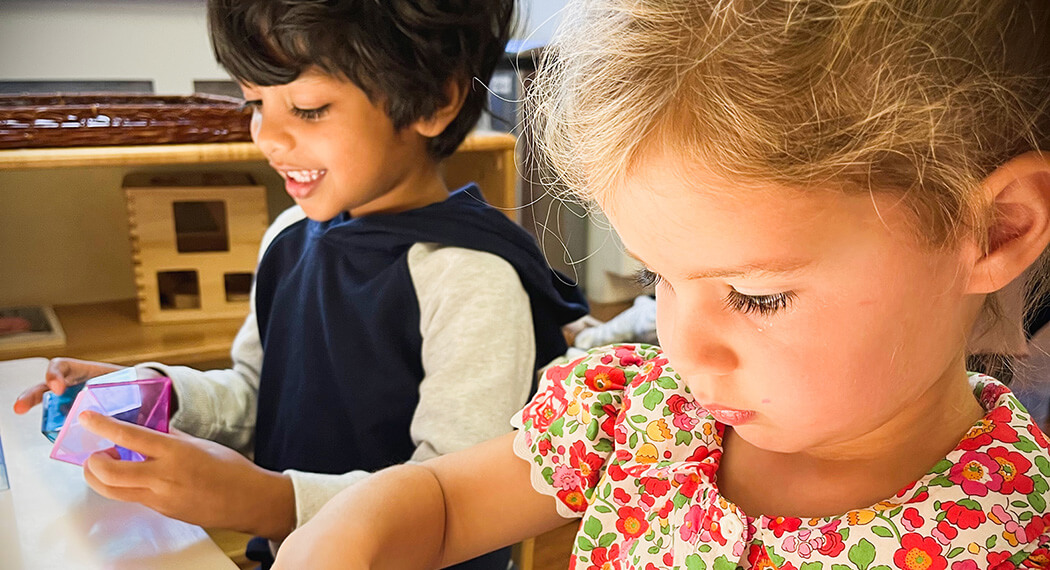
First, we met on the roof, and the students created patterns using shape blocks on sunprint paper*.
*What is a sunprint, you may ask? Also termed cyanotypes, or photograms, sunprints are monochrome prints or images made by exposing chemically treated paper to UV light (the sun).
Each child created a symmetrical pattern on a whiteboard, thinking about what makes a pattern symmetrical, and then transferred their design to their paper. Then the paper with the symmetrical pattern was left out in the sun for a few minutes. The next step was to develop the prints by placing them under cold water and allowing them to dry. (The ferrous salts in the paper react to form an insoluble, deep blue pigment called Prussian blue, while the areas that were covered remain white, resulting in a negative image. The blue color intensifies as the print dries and fully oxidizes.
So much fun the students start to work together to create a symmetrical design on a white board…
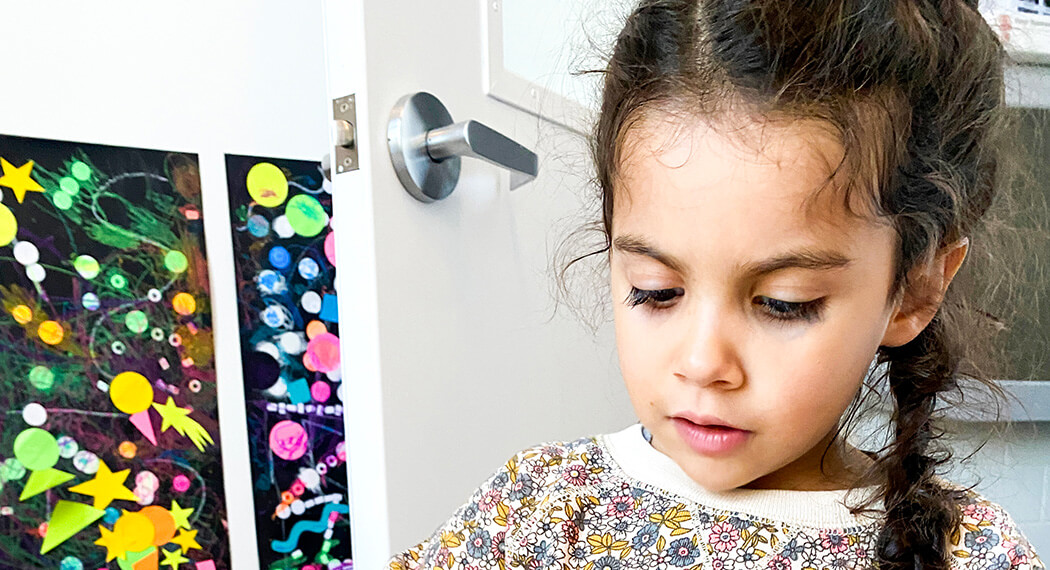
The following week, the students used paint on paper to think about and create symmetrical designs.
We started out by looking at the book What is Symmetry in Nature by Bobbie Kalman. We discussed how symmetrical designs are precise mirror images of something, not merely designs that have a general resemblance on both sides. The children made book folds in their paper, chose one side, and painted a design using dots, squiggles, and lines on that one side only. Some of the children asked how they would create a symmetrical design on the other side if they were not allowed to paint it. With a bit of thought, the students figured out that when they folded their paper so the two sides met, the paint on one side would transfer to the other, creating a symmetrical design. There was a lot of discussion about why some of the paint didn’t transfer as well – “Maybe we need more paint,” “Maybe the paint dried too fast,” “What if we made the paint more gloopy!”
– Can you find your child’s designs?
– How are your children using symmetry at home?