


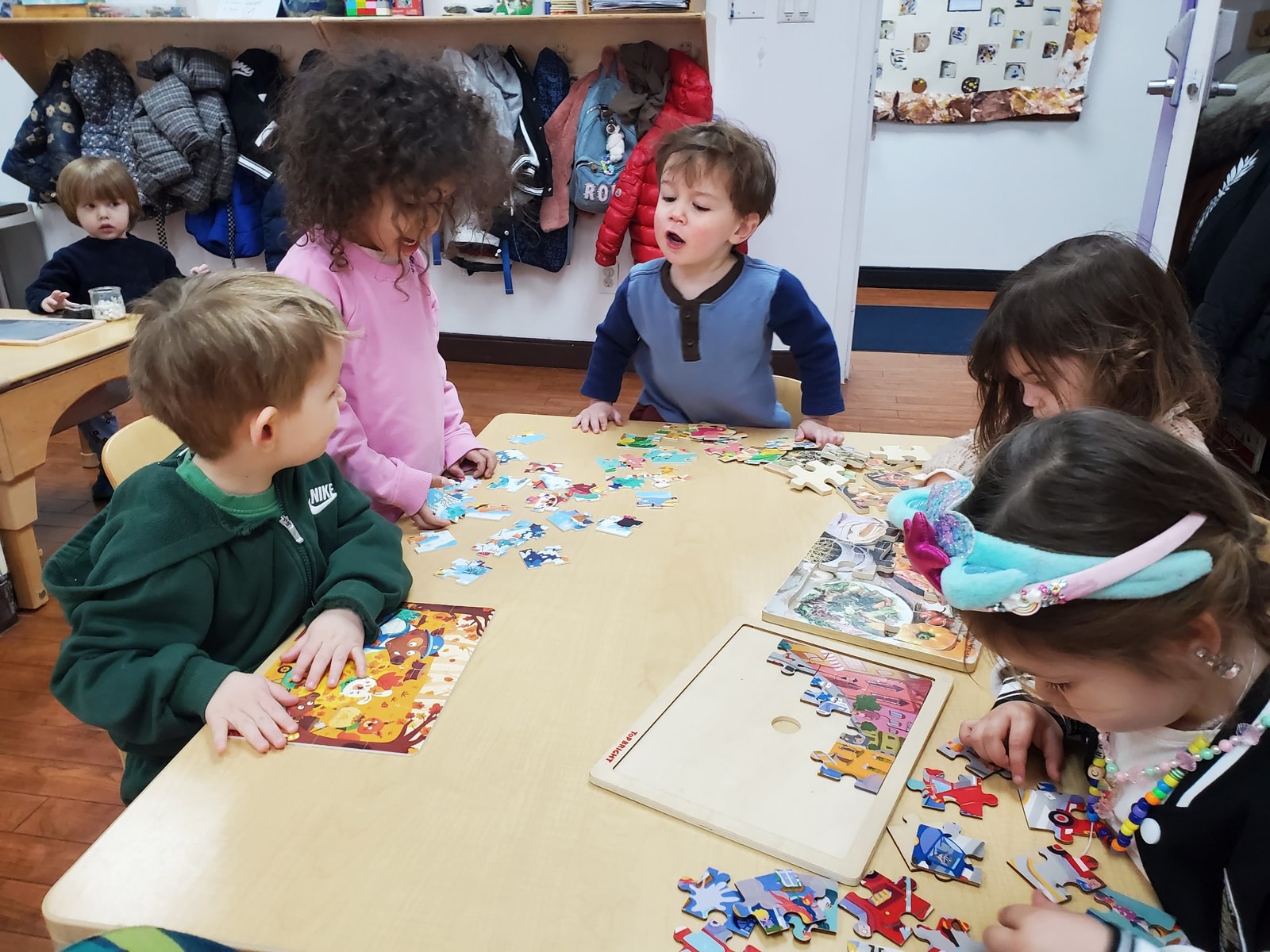
Over the past month or so, we’ve noticed a renewed interest in puzzles. The Ice Creams returned to some of their favorite puzzles from the fall, growing their mastery, speed, and confidence. They’ve since moved on to increasingly challenging puzzles, including 28-piece jigsaw puzzles, puzzles with unusual shapes, and puzzles without a frame.
Below, we’ve shared some of our classroom strategies for puzzles, as well as offering a look at the different types of puzzles that we have in our classroom.
Puzzle Strategies
Puzzles are a great way to build problem-solving skills and persistence. We have a number of strategies that we teach to students as they first begin working on puzzles. As each child’s skillset grows, we peel back our support to encourage independence and confidence.
– Flip over all of your pieces when you start, so that you can more easily find the pieces that you need. (We’ve noticed that as kids grow more confident, they may challenge themselves by keeping the pieces face-down and only flipping over one piece at a time.)
– Check to see if the picture matches. When the Ice Creams put two pieces together, we might ask, “Do those pictures match?” We encourage them to take a close look at the colors or the objects in the puzzle’s picture to double-check their work. For example, with our food puzzle, we might prompt a student by asking, “Can you match the two pieces of the lime?” or, “Can you find the tortilla piece?”
– Turn the piece in different directions to find the ‘just right’ fit. We often hear kids reminding each other: “Try a different way,” or, “Turn it!”
– Identify corners and edge pieces. This is a skill that many of the Ice Creams are still working on! We say that the edge pieces have a “flat side.”
– If a piece doesn’t fit, try something new! Many students, when they first try jigsaw puzzles, can get ‘stuck’ on a puzzle piece that doesn’t yet fit on their board. When this happens, we say, “Maybe you’re not ready to put that piece in yet. Let’s try another piece instead!”
A Puzzle Continuum
We have many different types of puzzles available in the Purple Room, reflecting various skillsets and interest. We’ve noticed that the Ice Creams will ‘land’ on different levels of the continuum on different days. Some days, a student may want to return to a puzzle that they’ve already mastered, to test their speed or challenge themselves to complete the puzzle in a new way. Other days, the same student might want a teacher to support them as they try a puzzle just beyond their comfort zone.
Peg Board Puzzles
All of the Ice Creams can successfully complete peg board puzzles. With this type of puzzle, they are building the hand-eye coordination necessary to place puzzle pieces in their correct spot. This is a great place to practice turning the pieces to find the ‘just right’ fit.
Jigsaw Puzzles with Reference Photo
A great way to introduce jigsaw puzzles is by taping the image to the puzzle frame (some include this already, but it’s easy to add). The kids can then use the photo as a reference point, checking that their pieces are in the correct spot. For this type of puzzle, we might say things like: “Hmm, I wonder where you see that daddy’s hand in the picture. Can you match your piece to the picture?”
Jigsaw Puzzles without Reference Photo
This type of puzzle challenges the Ice Creams to master their matching skills. They have to look closely at the image on each piece in order to find its correct place. As an added challenge, these types of jigsaw puzzles often have pieces that technically fit together even when the picture doesn’t match. This encourages persistence and increases frustration tolerance!
Let’s zoom in on one of the Ice Creams’ all-time favorite puzzles. This 28-piece firetruck puzzle frequently has a waiting list! When a child first approaches this puzzle, we encourage them to start with the row of houses along the top. These pieces are colorful and distinct, making them easier to identify. We’ll say, “What color is that house? Can you find another house piece that matches?” We might also offer situational cues, such as asking, “I wonder where that police officer might go. Do you think they should go near the police car?”
Jigsaw Puzzles without a Frame
When working on a puzzle that does not have a frame, the Ice Creams are growing their awareness of edge and corner pieces. They no longer have the frame to show them the boundaries of the puzzle. Given this additional challenge, we typically choose puzzles with fewer pieces (9-16). Floor puzzles are another great example!
Teamwork / Partner Puzzles
At the end of our continuum are teamwork or partner puzzles. Working on a puzzle with a friend requires strong communication skills and cooperation, as you work together towards a common goal. Our hope is that, when kids work on a puzzle together, they offer each other support, encouragement, and suggestions.
We haven’t formally introduced this type of puzzle yet, though some of the Ice Creams have naturally started to work together when approaching trickier puzzles!