





Independence in the Toddler Years
A key milestone of the toddler years is the need for increasing independence, something you are likely also noticing at home. Children desire to complete tasks on their own, seek risks to take, and form identities separate from their grownups. This often bumps up against a parallel need to remain close to supporting and comforting grownups. Children want to know that their grownups will return after time away, continue to care for their boo-boos, and offer help in requested moments. But, there is a duality in these needs – when children are rooted in secure, supportive, and trusting relationships, they are more inclined to push out of their comfort zones and to test their limits. Independence grows because children know that their grownups will offer assistance, if and when they need it.
Through months of zooming in and forming relationships with one another, we have learned about each child’s individual identities (family, special objects, likes, dislikes) and how they process changes and emotions. The children, in turn, learned that we, as their teachers, will always be here to offer care and comfort, just as their home grownups do. Each interaction has contributed to the creation of a classroom community of children, teachers, and families built on trust, support, security, and understanding.
Now that we have laid the foundation, it is an ideal time for us to begin stepping back to give the children space to grow and experiment with their budding independence. We continue to be fully present and engaged, but are making conscious choices as to when to intervene, offer help, and encourage struggles. Here are some of the ways in which we are doing so:
Honoring Choices
The ability to choose is a crucial component of independence. It offers children the opportunity to voice their preferences, say “no” during moments of opposition and difference, and begin to see themselves as separate from their special grownups. They are individuals with their own thoughts, wants, and needs.
Entry: The beginning of the day feels different for each child. Some children eagerly enter the classroom space and immediately join in an activity. Others may choose to linger by the doorway or stand by a teacher, using the initial moments to observe and collect information about the environment and people. It is important to recognize and honor the contrast in personalities between these two groups. For children ready to engage, various material invitations welcome them each day – dramatic play, sensory, gross motor, art, building, books. They may freely choose amongst these, guided by their interests and inclinations. For children needing a moment, we step back after our initial invitations into the classroom and give them the space and time to settle in. They are aware of our presence, but we choose not to impose on this internal moment. When they are ready to engage with us, their peers, or materials, they will take the steps to do so.
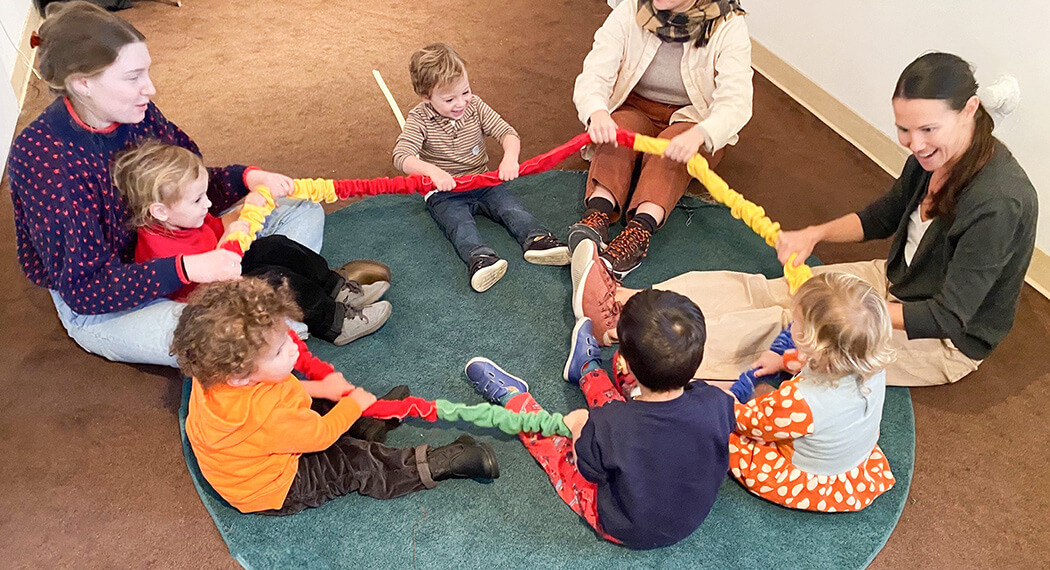
Meetings: At this point in the year, the children have internalized many of our classroom songs. They are able to “read” our song cards, using the illustrations to call out song names. They actively join in to sing along and make hand movements. And, they are eager to make requests for specific songs of their choosing. We recently incorporated these developments into our meetings by giving them the opportunity to decide on their transition-to-handwashing song and taking turns to choose between two options.
Self-Help Skills
Up until the toddler years, almost everything has been done for children – putting on clothes, bathing, feeding, transporting between places. As their need for independence grows, they begin to resist adult help and insist that they have the opportunity to perform these tasks themselves (“I do myself!”). For new skills, it often helps to start the process for them and then let them complete it, with guidance as needed.
Dressing: Putting on coats, clothes, and shoes comes easily to adults, but for children, they need guidance and extra time to engage in these processes. If children choose to take off their shoes during their time at school, we encourage them to do so themselves. We may help to untie shoelaces, but show them how to pull off each shoe from the heels. When they are ready to put them back on, we guide them through the process. Sometimes, we do this by helping them to start or hand-over-hand, but we generally want them to be part of the process as much as possible (though we also recognize that that is not always possible!).
Putting on coats and accessories is now a part of our routine, generally preceding our trips to the roof. We encourage children to put on their hats and for those who are ready to try their coats, we demonstrate the flip technique. This involves placing the coat on the ground, zipper side up with the hood facing the child. Then, the child slips both of their arms into the sleeves, lifts the coat off the ground and over their head, and flips it into place on their body.
Diapering: Since infancy, children have become accustomed to being laid down for diaper changes. In the toddler years though, their bodies are experiencing a number of physical changes (growing height, developing muscles) alongside an increasing need for independence. They may feel restricted within the confines of a changing table or mat, and resist the experience. While we may have done some changes laying down in the initial weeks, the children have now all transitioned to stand-up changes here in the classroom. During these changes, they are encouraged to assist in the process by pulling down/up their pants, holding up their shirt, and finding a sturdy position to stand in (sometimes, that involves touching their toes for number two changes).
Handwashing: A regular part of our routine, and one that children are often excited about, handwashing involves a number of steps that offer them the opportunity to lean into their budding independence – stepping onto/off the stool, rolling up their sleeves, turning on/off the faucet, getting soap, scrubbing and rinsing, getting a paper towel. As much as possible, we attempt to encourage children to carry out these steps on their own. Like dressing, we sometimes guide them by helping them to start or hand-over-hand, and as they become more confident in their skills, the children often nudge our hands aside to say, “Myself!”
Snack: In the early months, as the children were learning to trust that we can meet basic needs like hunger and thirst, we offered servings of food and water as requested throughout snack time. This included when they may have already shared that they were “all done,” only to return for another serving. In doing so, the children have learned that we, like their home grownups, are here to take care of their different needs. With this understanding in place, we are now inviting children to take a more active role in the clean-up process. When they feel finished, they are asked to bring their cup and bowl over to a bin stationed by the trash can, offering a clear visual and verbal “all done” reminder should a child return moments later to ask for more food. We do want to note that if a child insists that they are still hungry, this need will not go unheard. Similarly, there is always an option for a cup of water during snack and as needed throughout the day.
Transitions: Transitions are a regular part of our day, from entering the classroom, gathering for meetings, to lining up for the elevator. Some of these are accompanied by a song and a physical space to gather. And, we recently introduced “the blue line.” This is the line where we gather to put our toes on before we transition out of the classroom. The children are working hard on finding space for themselves in relation to peers and waiting patiently as everyone gathers.
Moments of Conflict
Conflicts are an essential part of toddlerhood and are very much embedded into our day to day in the White Room. As adults, we are often inclined to jump in and intervene as quickly as possible when we notice children in conflict. We want to help them. We want to prevent frustrations and tempers from escalating. We want everyone to be happy and content. But, it is important to acknowledge that children need to personally encounter, experience, and learn about conflicts. With each conflict, they build the tools and confidence to eventually resolve similar moments on their own.
As such, we are intentionally choosing to let conflicts, both personal and social, happen within the supportive community and environment we have created together. While remaining present nearby, we want the children to struggle a little, feel frustrated, try again, and figure things out on their own before intervening to offer support and guidance. We also want them to be the first to ask for help, honoring their individual processes.
Personal: These conflicts refer to those that emerge from a child’s independent work (i.e., attempting a puzzle, trying to open a box or door, building a tower that keeps falling). Children often feel frustrated and annoyed when their first attempts do not lead to an immediate sense of satisfaction. They do not understand what went wrong and only wish for the process to be easier. They recognize and know that adults are reliable resources, so can be quick to turn to them for help. In these moments, we acknowledge the children’s feelings while encouraging them to keep trying (i.e., “I see you are working so hard,” or “Sometimes, our structures fall down, but that is okay. We can just build it again!”). If they continue to struggle after an attempt or two, and are beginning to show exhaustion with the work, we motivate them by offering suggestions rather than doing it for them (i.e., “What would happen if you turn the puzzle piece this way?” or “I noticed you tried to stack a bigger block on top of a smaller block. What happens if you stack the smaller block on top of the bigger block?”). In this way, while we are giving advice that may lead to some sort of success, the children continue to be part of the problem solving process.
Social: At this point in the school year, the children are becoming increasingly interested in their peers. This is the beginning of social curiosity and friendships. They want to join in play and work together. They want what their peers have. They play with some peers, but not others. In the midst of these developments, the conflicts that emerge and continue to emerge include sharing, turn taking, social invitations/exclusions, body awareness, and awareness of others’ feelings, wants, and needs. While the children may have some of the language to handle these moments, more often than not, they are still learning how to use them. But, they can only do so if they have the opportunity to practice. Again, we step back and give them a chance to struggle a little with their peers, even if it means there is a tug-of-war with the materials. If the situation escalates, we then step in to help the children make sense of what is happening. We model language that they can use in such moments (i.e., “I am using that.” “I am not done yet.” “Can I have a turn?” “Can I play with you?” “What are you doing?”). We essentially become facilitators in this process.
As you can see, there is a lot of growth and learning happening here in the White Room, through moments small and big. The children are working so hard, and we are proud of all that they do each and every day. Look out for an upcoming post about how your child may be leaning into these areas here at school!
Ask Your Child
What did you have for snack? Did you take your cup and bowl to the bin after?
Did you put your toes on the blue line today? Where did you go after?
Who did you play with? Did you and [another child’s name] do lots of running [or another activity] together? [It can be helpful to use the face-to-name sheet we shared earlier in the year for conversations about peers.]