






Part 1:
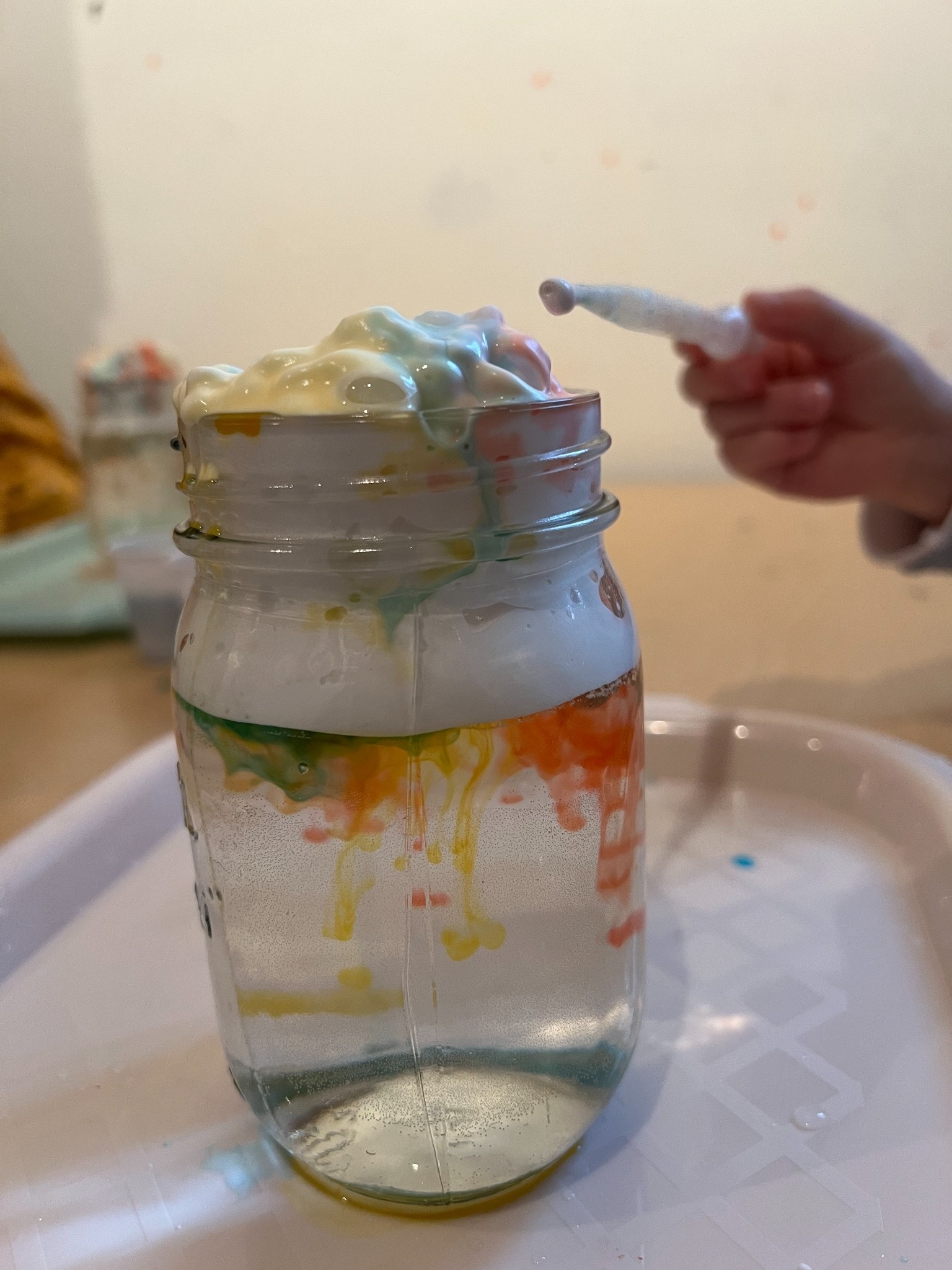
How can we engage our creativity and imagination, AND learn about how it rains? Ask a student in the Green Room. Sometimes, you only need a picture book, a jar, a pipette, water, shaving cream, and food coloring. Creating a cloud in a jar provides a simplistic model, offering a hands-on visual of how it rains.
The science: Clouds are formed as water vapor rises into the air. As it rises, the water vapor collects small dust and debris particles, forming droplets. As these droplets condense, they form clouds. Rain forms when droplets and debris crystals in the cloud become heavy, and gravity pulls them down towards the Earth as raindrops.
Part 2:
The Green Room students continued their exploration of the water cycle by examining clouds and their saturation point. To model the saturation point of a cloud, the students used cotton balls, colored water, and a pipette. They predicted how many drops of water would be needed to thoroughly saturate the cottonball “cloud” so that gravity would induce “rain.” They also considered the water cycle, how rain falls to the ground and collects in bodies of water such as ponds, lakes, and streams, before returning to the sky as evaporation and condensing in clouds. They will continue to learn these words as we continue thinking about the water cycle in science.
Before testing their predictions, they watched a portion of the SciShow Kids video “Where Does Water Come From?” (https://www.youtube.com/watch?v=R0K7VKkksyc) and discussed what they remembered about clouds, precipitation, and the water cycle. They talked about rainfall and evaporation. Connections were made to how the seasons cycle as well.